
Passport Photo Size by Country: The Complete 2026 Guide
Last updated: April 2026 | Verified against official government sources
Your passport photo is wrong size by two millimeters. Your application gets rejected. You lose three weeks and $35 in fees starting over.
This scenario plays out thousands of times a year because passport photo size by country isn’t standardized. The United States requires a 2×2 inch square. The UK uses 35×45 millimeters. Canada demands a unique 50×70 millimeters. China wants 33×48 millimeters. Get even one specification wrong and the embassy, consulate, or passport office sends your paperwork back with a form rejection letter.
This guide covers the exact passport photo size by country for 40+ nations, current as of 2026, with the head-size ratios, background requirements, and digital file specifications that matter. If you’re preparing a visa application, renewing a passport, or submitting an immigration form, bookmark this page.
Quick Reference: Passport Photo Size by Country
Here’s the fast summary for the 20 most commonly requested countries. Detailed specs with head-size ratios and digital file requirements follow below.
| Country | Photo Size | Background | Prints or Digital? |
|---|---|---|---|
| United States | 2×2 inches (51×51mm) | White | Both accepted |
| Canada | 50×70mm | White | Both (prints required for mail-in) |
| United Kingdom | 35×45mm | Light grey or cream | Digital preferred |
| Schengen Area (EU) | 35×45mm | Light grey or white | Prints (consulate submissions) |
| India (within India) | 35×45mm | White | Digital + prints |
| India (OCI / US-based) | 2×2 inches (51×51mm) | White | Digital |
| China | 33×48mm | White | Both |
| Mexico | 35×45mm | White | Prints (3 required) |
| Japan | 35×45mm | White or light blue | Both |
| South Korea | 35×45mm | White | Both |
| Australia | 35×45mm | Plain light | Both |
| New Zealand | 35×45mm | Plain light | Digital preferred |
| Brazil | 50×70mm | White | Prints |
| Turkey | 50×60mm | White | Prints |
| UAE | Varies by document | White | Digital |
| Singapore | 35×45mm | White | Digital |
| Thailand | 35×45mm | White or light blue | Prints |
| Vietnam | 40×60mm (passport) or 35×45mm (visa) | White | Both |
| Philippines | 2×2 inches (51×51mm) | White | Both |
| South Africa | 35×45mm | Plain, light | Prints |
Most countries follow one of three main passport photo size standards: the 2×2 inch square (US, Philippines, sometimes India), the 35×45mm rectangle (UK, Schengen, most of Asia and the Pacific), and the 50×70mm format unique to Canada. A handful of countries (Brazil, Turkey, Vietnam) use their own specifications.
Need compliant international passport photos in Phoenix? Our downtown studio shoots to every country’s exact specification, with same-day digital delivery and a retake guarantee if your photo gets rejected. See our passport photos Phoenix service →
United States — 2×2 Inches (51×51mm)
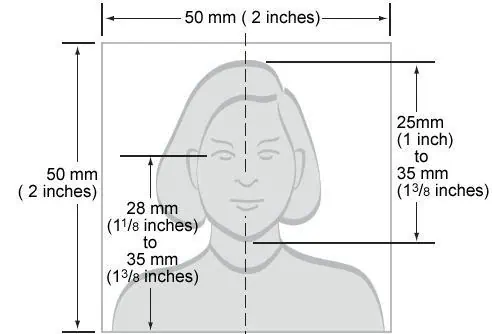
The United States uses a 2×2 inch square format for passports, visas, Green Cards, and most USCIS immigration forms. This is one of the most permissive standards globally — a single file size applies across nearly all federal documents.
- Print size: 2×2 inches (51×51mm)
- Head size: 1 to 1⅜ inches (25–35mm) from chin to top of head — roughly 50–69% of image height
- Background: Plain white or off-white, no shadows
- Digital file: JPEG, 600×600 to 1200×1200 pixels, file size 240KB to 5MB
- Retouching: Not permitted — no filters, AI alterations, or photo editing
- Glasses: Not permitted since November 2016
- Applications: US Passport (DS-11, DS-82), DS-160 nonimmigrant visa, Green Card, N-400 naturalization, I-765, I-131, Diversity Visa Lottery
The 2×2 inch US spec is available at FedEx and Walgreens for $15–17. For standalone US passport photos, retail chains are the most cost-effective option.
Canada — 50×70mm (Unique Format)
Canada has the strictest passport photo requirements of any major country. The 50×70mm format is unique to Canada and cannot be substituted with the US 2×2 inch or international 35×45mm formats.
- Print size: 50×70mm (approximately 2×2¾ inches)
- Head size: 31–36mm from chin to crown of head
- Background: Plain white, no shadows or patterns
- Photographer requirement: Commercial photographer required — self-taken or booth photos rejected
- Back-stamp requirement: Photographer’s studio name, complete address, and date must be printed on the back of both photos — stick-on labels not accepted
- Guarantor signature: Required on one of two photos (must be Canadian citizen who has known applicant 2+ years)
- Prints required: Two identical photos for passport applications
- Digital: Even online renewals require a digital file taken by a commercial photographer
- Applications: Canadian Passport, Citizenship Certificate, Permanent Resident (PR) Card
Most US retail chains (Walgreens, FedEx, CVS) cannot produce compliant Canadian passport photos because they don’t offer the 50×70mm format, don’t provide back-of-photo stamping, and don’t include a digital file.
United Kingdom — 35×45mm
The UK is one of the few countries that prefers a light grey or cream background rather than pure white. Pure white backgrounds can confuse the HM Passport Office’s automated verification system.
- Print size: 35×45mm
- Head size: 29–34mm from chin to crown
- Background: Light grey or cream — NOT pure white
- Digital file: JPEG, minimum 600×750 pixels, maximum 6.5MB
- Online submission: Preferred through HM Passport Office digital portal
- Expression: Neutral, mouth closed, both eyes visible
Schengen Area (European Union) — 35×45mm
The 26 Schengen Area countries (Germany, France, Italy, Spain, Netherlands, Belgium, Austria, Portugal, Greece, and others) all use a standardized 35×45mm format for visa applications. Requirements are harmonized under EU biometric standards.
- Print size: 35×45mm
- Head coverage: 70–80% of photo height (face should dominate)
- Background: Light grey or white, no shadows
- Recency: Taken within the last 6 months
- Expression: Neutral, mouth closed, both eyes open
- Biometric compliance: Must meet ICAO 9303 standards for machine-readable travel documents
- Prints required: Most Schengen consulate submissions still require physical prints
India — Three Different Specs Depending on Application
This is where most people get rejected. India uses three different passport photo specifications depending on which document you’re applying for and where you’re applying from:
Indian Passport (applying within India)
- Size: 35×45mm
- Background: White
- Digital upload: 630×810 pixels (new 2026 spec)
Indian Passport / OCI Card (applying from US)
- Size: 2×2 inches (51×51mm)
- Background: White
- Digital upload: 350×350 to 1000×1000 pixels, file size 10KB–300KB
Indian Visa (e-visa portals)
- Size: 2×2 inches (51×51mm)
- Background: White
- Digital only: JPEG, 10KB–300KB file size
The critical mistake: uploading a 35×45mm photo to the US-based OCI portal or vice versa. Each system rejects the other’s format. Always confirm which spec your specific application requires.
Confused by India’s three different specs? That’s exactly why international passport photo work belongs in a specialty studio. Our Phoenix team maintains current specifications for every country and knows which one applies to your specific application path. Book your passport photo session →
China — 33×48mm
China uses a unique 33×48mm format for visa applications, different from any other major country’s specification.
- Print size: 33×48mm
- Head size: 15mm minimum face width, 28–33mm head height
- Background: Plain white, no shadows
- Digital file: 354×472 pixels, JPEG, 40KB to 120KB
- Prints required: Yes, for in-person consulate submissions
- Expression: Neutral, mouth closed, ears visible
Mexico — 35×45mm (Three Prints Required)
Mexican passport applications require three identical printed photos — more than any other major country. Mexico also has specific rules about eyewear that differ from US standards.
- Print size: 35×45mm (3.5×4.5cm)
- Quantity required: Three identical printed photos for passport applications
- Background: Plain white
- Head size: 30–36mm from chin to top of head
- Glasses: NOT permitted — even prescription glasses must be removed
- Recency: Taken within 30 days of application
- Expression: Neutral, no smile
- Other Mexican IDs: Cédula profesional, teacher credentials, and consular IDs often use variations of the 35×45mm format but may have different head-size requirements
Japan and South Korea — 35×45mm
Both Japan and South Korea use the 35×45mm standard, though Japan sometimes accepts light blue backgrounds for certain applications.
Japan
- Print size: 35×45mm (4.5×3.5cm in Japanese notation)
- Background: White or light blue
- Head size: 32–36mm
- Recency: Within 6 months
South Korea
- Print size: 35×45mm
- Background: Plain white
- Head size: 30–35mm
- Digital portal submissions accepted for renewals
Australia and New Zealand — 35×45mm
Australia and New Zealand follow similar standards, with both accepting digital submissions for passport renewals from most countries.
- Print size: 35×45mm (45–50mm high, 35–40mm wide)
- Background: Plain light, no patterns
- Head size: 32–36mm from chin to crown
- Face coverage: 65–75% of frame
- Digital: Both countries accept online renewals with digital photos
USCIS Forms (US Immigration)
All US Citizenship and Immigration Services forms use the 2×2 inch format, consistent with the US passport standard:
- I-765: Employment Authorization Document — 2×2 inches
- N-400: Naturalization — 2×2 inches
- I-90: Green Card Renewal — 2×2 inches
- I-131: Travel Document — 2×2 inches
- DV Lottery: Diversity Visa — 600×600 pixels minimum, digital only
USCIS has recently tightened compliance for AI-altered photos. Any photo with visible retouching, filters, or algorithmic smoothing will be rejected under 2025 rules.
The 5 Most Common Reasons Passport Photos Get Rejected
Based on rejection data from passport processing agencies, these are the top failures regardless of which country’s passport photo size you’re targeting:
- Wrong dimensions — Most common by far. A 2×2 inch photo submitted for a Canadian application, or a 35×45mm photo for a US application. Always verify the exact spec for your target country before shooting.
- Wrong head size — Head too small or too large within the frame. Canada (31–36mm), UK (29–34mm), and Schengen (70–80% face coverage) all have narrow acceptable ranges.
- Wrong background color — Pure white when light grey is required (UK), or off-white when pure white is required. The automated scanning systems are strict about color tolerance.
- Retouching or filters — Any smoothing, AI enhancement, or visible editing triggers automatic rejection under most modern biometric standards.
- Outdated photo — Most countries require photos taken within 6 months. Mexico requires within 30 days. Canadian applications require current appearance matching any existing ID.
Digital vs. Print: What Your Application Actually Needs in 2026
The shift toward digital-only submissions continues to accelerate. Here’s the 2026 reality:
Digital-only (no prints required)
- US passport online renewal via MyTravelGov
- DS-160 nonimmigrant visa applications
- Most country e-visa portals (India, Turkey, Kenya, Sri Lanka, Vietnam, Cambodia)
- UK passport online renewal
- Most USCIS online filings
- Indian OCI renewal online
Prints still required
- Canadian passport applications (mail-in and in-person)
- Chinese visa (in-person consulate submissions)
- Mexican passport (three prints)
- Mail-in US passport (DS-11, DS-82)
- Many Schengen consulate visits through VFS Global
- Most Brazilian document submissions
When in doubt, check the specific application portal or embassy requirements rather than assuming your country allows digital submission.
When to DIY vs. When to Use a Professional Studio
For a standard US passport photo, DIY or retail chain ($15–17 at Walgreens or FedEx) makes sense. The 2×2 inch spec is forgiving and widely supported.
For anything else, professional studios are often the smarter choice:
- Canadian passports: Commercial photographer required by IRCC. No DIY option.
- Multi-country applications: If you need both a Schengen visa photo and an Indian OCI photo, a studio can shoot both specs from one session.
- Complex specs: Canada, UK grey background, India’s multiple formats, Mexico’s three-print requirement all benefit from professional handling.
- High-stakes applications: Green Card, naturalization, and immigration cases where rejection means weeks of delay.
- Time-sensitive applications: Rejection means starting over. Professional studios with retake guarantees eliminate that risk.
Getting Your Passport Photos Right the First Time
The passport photo size by country variation isn’t going away. If anything, specifications are getting stricter as countries adopt ICAO 9303 biometric standards and automated verification systems. A photo that was accepted two years ago may be rejected today under updated rules.
Three principles to follow for every international application:
- Verify the current spec directly from the issuing authority’s official website before shooting
- Distinguish between digital and print requirements for your specific application path
- Don’t retouch, filter, or AI-enhance the final image — these are the fastest route to rejection under 2025+ rules
Need an International Passport Photo in Phoenix?
Photo Fusion Studio shoots compliant passport and visa photos for Canada, UK, Schengen, India, China, Mexico, and 40+ other countries. Same-day digital delivery, retake guarantee if rejected, and expert handling of complex specs like Canada’s 50×70mm format or India’s three different digital specifications.
Book your passport photo session in Phoenix →
Downtown Phoenix: 600 N 4th St · (602) 899-2201
Related Resources at Photo Fusion Studio
- Passport Photos Phoenix Service Page — Book your session, pricing, and complete service details
- Professional Headshots in Phoenix — Corporate, LinkedIn, and executive headshots
- ERAS Medical Residency Headshots — AAMC-compliant photos for medical students
- Directions to Our Downtown Phoenix Studio
Official Government Resources for Passport Photo Specifications
- US Department of State — Passport Photos
- Canada IRCC — Passport Photo Requirements
- UK Government — Passport Photo Guidelines
- USCIS — Photo Requirements Guide
- European Commission — Schengen Visa Information
Passport Photo Size by Country: Frequently Asked Questions
What is the most common passport photo size worldwide?
35×45mm is the most widely used passport photo size globally, used by the UK, all Schengen Area countries, Australia, New Zealand, Japan, South Korea, Mexico, and most of Asia. The US 2×2 inch (51×51mm) format is the second most common, used by the United States, Philippines, and some Indian applications.
Can I use a US passport photo for other countries?
Usually no. The US 2×2 inch square format doesn’t match the 35×45mm rectangular format used by most of the world, or the unique 50×70mm Canadian format. A US-format photo submitted for a UK, Canadian, or Schengen application will typically be rejected.
Do all countries require printed photos?
No. Most 2026 applications accept digital-only uploads through official online portals. Countries that still require physical prints include Canada (passport applications), China (in-person visa submissions), Mexico (three prints required for passport), and some Schengen consulate visits. Check your specific application for requirements.
Can I retouch or filter my passport photo?
No. All major countries prohibit retouching, filtering, AI enhancement, and photo editing on passport and visa photos. Many countries now use automated systems that detect retouching and reject edited photos automatically. Even minor skin smoothing can trigger rejection.
How often do passport photo specifications change?
Requirements are updated periodically, especially as countries adopt ICAO 9303 biometric standards. India updated its digital specifications in September 2025, Canada tightened back-stamp requirements in 2024, and the US introduced stricter AI-detection in 2025. Always verify the current spec directly with the issuing authority before submitting.
What is the difference between passport photo and visa photo requirements?
For many countries, the specifications are identical. However, some countries use different sizes for different documents. UAE uses different sizes for Emirates ID versus visa applications. Vietnam uses 40×60mm for passports but 35×45mm for visas. Always check the specific document type you’re applying for.
Why do some countries reject photos with glasses?
Modern biometric systems need unobstructed views of eyes for facial recognition matching. The US, Mexico, UK, Schengen, and most major countries prohibit glasses in passport and visa photos. Religious head coverings are generally permitted if they don’t obscure facial features.


